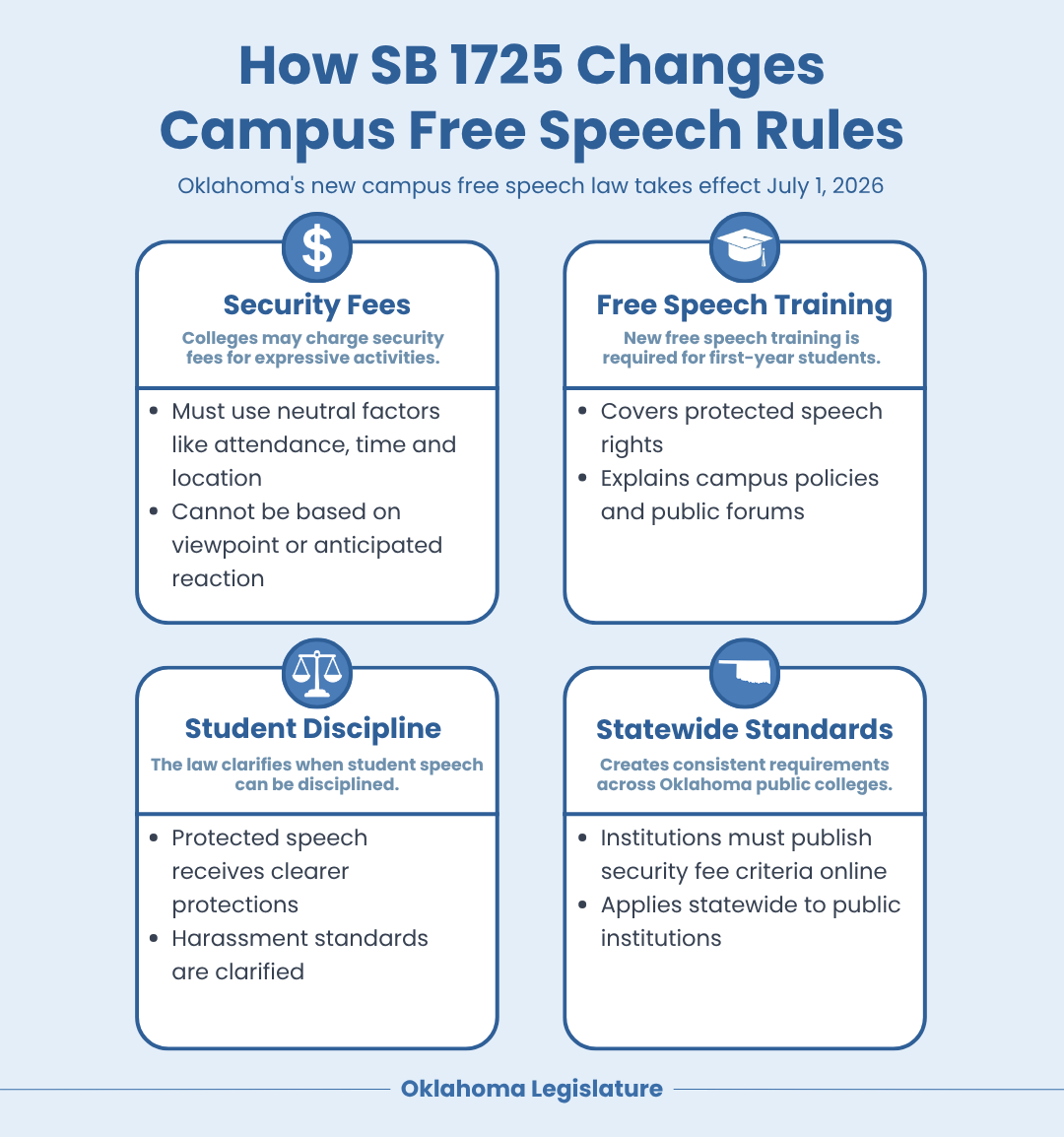
Oklahoma public colleges and universities will now have to prepare for new campus free speech requirements after Gov. Kevin Stitt signed Senate Bill 1725 into law, setting rules for campus security fees, student discipline and free speech training before the next academic year.
The measure passed the Senate 40-7 on March 25 and the Oklahoma House 78-15 on May 7.
Sen. Ally Seifried, R-Claremore, a co-author of the bill, said students should not expect many immediate changes on campus, but universities will need to review how they handle campus events and free expression policies before the fall semester.
“Senate Bill 1725 will go into effect on July 1, 2026,” Seifried said. “I wanted this measure to take effect over the summer to give colleges and universities time to adjust before the start of the fall semester.”
The law allows public colleges and universities to charge security fees to students or student organizations for permitted expressive activities, including events, speakers, protests and other forms of public expression. However, those fees cannot be based on the content of the event, the message of an invited speaker or the anticipated response from the student body.
Instead, universities must base security fees on neutral factors, such as the time or location of the event and the expected audience size. Institutions that charge security costs will also have to publish the criteria used to determine them on their websites.
Seifried said the legislation is intended to ensure campuses remain places where students can express ideas without fear of sanctions or censorship.
“I hope that, over time, this measure ensures that public college and university campuses continue to foster an environment that promotes free speech and the free flow of ideas and public discourse,” Seifried said.
Rep. Anthony Moore, R-Clinton, another co-author of the bill, said the measure was not written in response to one specific incident, but to broader concerns about campus speech policies, event planning and security costs.
“This wasn’t about a single incident — it’s really a response to broader trends we’ve seen on campuses, both in Oklahoma and across the country,” Moore said. “This bill is a proactive step to address those concerns before they become bigger problems.”
He said the biggest change for students will be clearer expectations for campus events.
“For most students, the biggest difference will be clarity,” Moore said. “There will be clearer guidelines on how events are planned and what to expect if additional security is needed.”
The law comes as universities across the state already have policies addressing campus expression, event approval and student organization activity. At the University of Oklahoma, student leaders said planning large events can involve complicated approval processes, safety requirements and costs.
Danica Triplett, a sophomore communications major at OU, Campus Activities Council homecoming chair and a member of Letters of Love, said she experienced those challenges while helping organize events on campus.
“There was a lot of security measures and things to do with food safety, general safety, renting the building and having waivers signed,” Triplett said. “It was a lot to keep track of.”
Triplett said high costs, limited funding and a lack of transparency can make it harder for student organizations to plan larger events, even when funding from OU’s Student Government Association is available.
“SGA funding is useful, but it is also very limited and spread very thin,” Triplett said. “The lack of transparency, and also how expensive things are, makes it difficult for people to make really interesting events with the constraints that they have.”
Triplett believes universities should still be responsible for managing safety at campus events, but students should be allowed to host a wide range of speakers and viewpoints.
“As long as there’s no clear threat, the university should allow anybody to have whatever speaker or event they want,” Triplett said. “If there are concerns about safety, then it should be the university’s responsibility to provide safety plans.”
Seifried said universities will have to make sure event policies do not become a hindrance for student organizations that want to host campus events or invite outside speakers. She said SB 1725 should make event planning easier by giving students access to detailed information about security fees on their college’s website.
The law is also intended to prevent higher education institutions from using costly security fees to deter students from hosting certain events or bringing polarizing speakers to campus.
“Protecting free speech on campus also means creating an environment where students have their viewpoints challenged and they learn to question and debate ideas presented by their peers,” Seifried said.
SB 1725 limits when universities can treat student expression as harassment. Public colleges and universities cannot punish students for speech unless it meets the law’s definition of harassment.
The law defines a material and substantial disruption as conduct that significantly hinders another person’s expressive activity, prevents the communication of a message or prevents a lawful meeting, gathering or procession from taking place.
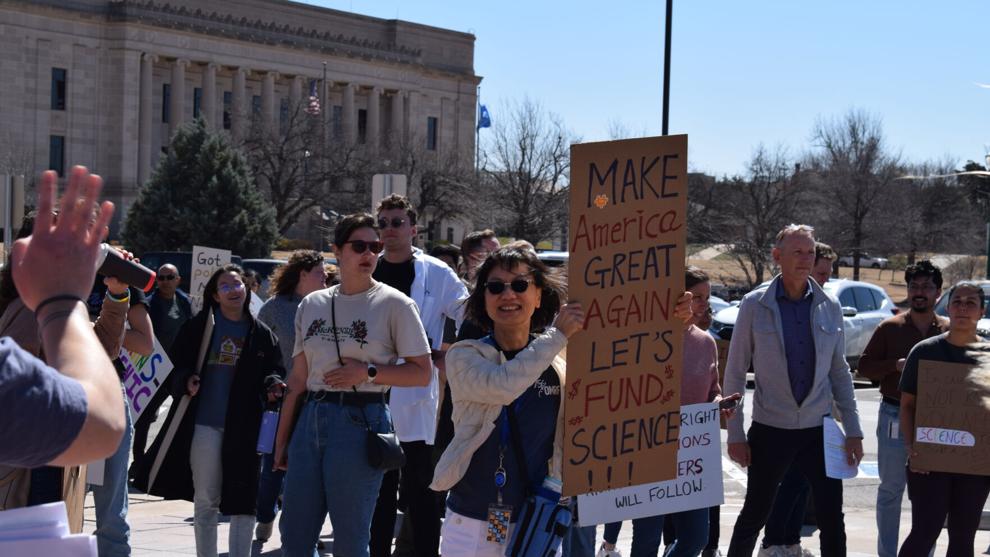
The measure also says generally accessible outdoor areas of campus are considered public forums for peaceful expressive activity. That includes lawful protests, speeches, guest speakers, distributing literature, carrying signs and circulating petitions, as long as the area has not already been reserved for another event.
Universities are still allowed to respond to unprotected speech and major disruptions to campus procedures or another person’s expressive activity. Schools may still provide support to students affected by speech that does not meet the law’s standard for discipline.
Some students said they support free speech protections in theory, but questioned whether the Oklahoma campuses face a widespread institutional free speech problem.
Ely Hull, an OU linguistics major who has also taken classes at SWOSU, said the law sounds positive at first.
“On the surface level, it sounds good,” Hull said. “Who is opposed to protecting free speech?”
But after reflecting, he said he does not see a major free speech problem coming from universities themselves. He said students may still feel pressure when having conversations around campus, but described that as more social than institutional.
“I don’t think so at the institutional level,” Hull said. “You can feel pressured by what your peers believe, but there aren’t any extensive institutional pressures.”
To Hull, the debate over campus speech also raises a broader question about whether lawmakers are focused on the issues students face most often.
“I just don’t think American academia has so much of an issue within governing itself,” Hull said. “I think the issue lies more with college not being accessible to people.”
For students, the required free speech training may be one of the first parts of the law they encounter.
SB 1725 requires first-year students at Oklahoma public colleges and universities to complete the training. The requirement also applies to transfer and graduate students in their first year at an institution.
Seifried said she expects the training requirement to fit naturally into existing orientation activities for first-year students.
“This could take the form of a seminar at orientation, online training prior to the start of classes or whatever the university deems necessary to ensure all first-year students know that their free speech rights don’t end the moment they set foot on campus,” Seifried said.
Universities may develop their own training, but it must be recommended by the Oklahoma Free Speech Committee and approved by the Oklahoma State Regents for Higher Education.
The training must include each institution’s campus free speech policies. It must also cover campus time, place and manner restrictions, the difference between protected and unprotected speech, academic freedom, how students can respond to speech they disagree with and how to file a complaint if they believe their rights were violated.
Diane Gueyffier, a junior business major at OU and an international student from France, said the training requirement could be helpful because many students may not fully understand free speech and harassment policies when they first arrive on campus.
“I think it’s a good thing,” Gueyffier said. “Not a lot of people are aware of this stuff.”
Hull said he believes the training could help students who have not learned much about First Amendment protections, even if some students treat it as another requirement to complete quickly.
“I think it would probably be beneficial in some aspect,” Hull said. “A lot of students would get frustrated having to take it, because I’m sure a lot of them already know it, but for the ones that don’t, it would be beneficial.”
Shelby Cole, a sophomore film and entertainment major at SWOSU, said the training could be useful for students who are unsure what free speech allows and what its limits are.
“A lot of them don’t know what free speech entails,” Cole said. “I think most people here will speak what they want, and no one’s really going to have a problem with it unless you’re going overboard.”
SB 1725 requires public institutions to develop materials, programs and procedures to help faculty, staff and campus officials understand free expression policies.
Some campuses already have policies in place. OU and SWOSU both have campus expression policies addressing protests, demonstrations and other expressive activity. OU’s policy defines expressive activity as communication through speech, literature, demonstrations or protests, while SWOSU’s policy states that the university will not restrict speech based on content or viewpoint.
Public colleges and universities will also be required to send an annual report to the governor, the Legislature, the state system chancellor and the Oklahoma Free Speech Committee by Dec. 31, detailing how they have met the law’s requirements.
The law reflects a broader national debate over free speech on college campuses, where lawmakers, universities and students continue to debate how to balance open expression with student safety and institutional responsibility.
For students like Cole, the conversation comes down to whether campuses can make room for disagreement while still maintaining clear expectations.
“We can have conversations, that’s where it starts,” Cole said.
Gaylord News is a reporting project of the University of Oklahoma Gaylord College Journalism and Mass Communication. For more stories by Gaylord News go to Gaylord News.Net